Showing posts with label wind. Show all posts

Saturday, January 31, 2009

The American Recovery & Reinvestment Plan

Per the $825 Billion President Obama U.S. Economic Stimulus Package, the Senate is currently proposing that $340 Billion will allocated to rebuilding America's economy via The American Recovery and Reinvestment Plan. Below are the current specific financial highlights of the The American Recovery and Reinvestment Plan courtesy of the U.S. Senate Appropriations Committee 1/23/09 press release (FYI, the link to the seven page press release is included at the bottom of this post).

Please be advised that the disclosed plan below is subject to revision as it will be reviewed on the floor of the U.S. House of Representatives next week.


-------------------------------------------------------------------------------


The American Recovery and Reinvestment Plan:


The American Recovery and Reinvestment Plan focuses on 5 critical areas to rebuilding our economy and creating the conditions for economic growth in the long-term :


* Infrastructure and Science - $140 Billion


* Education and Training - $125 Billion


* Energy - $51 Billion


* Protecting the Vulnerable - $25 Billion


* Health - $16 Billion


It is estimated that this legislation will create or sustain 4 million American jobs.


* Infrastructure and Science: $140 Billion

In order to rebuild our weakening economy, these investments in our physical and cyber infrastructure will put Americans immediately to work rebuilding our crumbling roads and bridges, and will also enable the creation of a stronger and more efficient infrastructure for the 21st century economy. Highlights include:

School Modernization: $16 billion to repair, renovate and construct public schools in ways that will raise energy efficiency and provide greater access to information technology, and $3.5 billion to improve higher education facilities.

Broadband: A total of $9 billion for the National Telecommunications and Information Administration’s (NTIA) Broadband Technology Opportunities Program to improve access to broadband.

Public Parks: $3.4 billion for repair, restoration and improvement of public facilities at parks, forests, refuges and on other public and tribal lands.

Department of Defense Facilities: The stimulus includes $2.4 billion for quality of life and family-friendly military construction projects such as family housing and child care centers.

• $3.2 billion for Facilities Sustainment, Restoration and Modernization to be used to invest in energy efficiency projects and to improve the repair and modernization of Department of Defense facilities to include Defense Health facilities.

• $3.4 billion for VA hospital and medical facility construction and improvements, longterm care facilities for veterans, and improvements at VA national cemeteries.

• $1.2 billion to accelerate procurement and installation of baggage screening and checkpoint security equipment at airports across the country.

• $500 million to secure high risk critical infrastructure such as dams, tunnels, and bridges.

• $4.6 billion to construct, repair or rehabilitate water resource infrastructure nationwide to benefit navigation, hydropower, flood control, environmental restoration, shore protection and other purposes.

• $1.4 billion to construct, repair, or rehabilitate water delivery infrastructure in the Western U.S. to benefit irrigation, municipal and industrial water supplies, power production, and environmental and other purposes.

• $2.25 billion for the HOME Investment Partnerships Program block grant to enable state and local governments, in partnership with community-based organizations, to acquire, construct, and rehabilitate affordable housing and provide rental assistance to poor families.


Transportation:

• $27 billion for formula highway investments.

• $8.4 billion for formula investments in public transportation.

• $5.5 billion for competitive grants to state and local governments for surface transportation investments.

• $1.3 billion for investments in our air transportation system.

• $1.1 billion for investments in rail transportation.

• $160 million for investments in maritime transportation.

• Public Lands Roads: $830 million for repair and restoration of road on park, forest, tribal, and other public lands.


Public Housing:

• $5 billion to the public housing capital fund to enable local public housing agencies to address a $32 billion backlog in capital needs - especially those improving energy efficiency in aging developments.

• $2.1 billion for full-year payments to owners receiving Section 8 project-based rental assistance.

• Neighborhood Stabilization Program - The bill includes $2.25 billion for the redevelopment of abandoned and foreclosed homes.

• Homeless Prevention Fund - The bill includes $1.5 billion for homeless prevention activities, which will be sent out to states, cities and local governments through the emergency shelter grant formula.


Environmental Clean-Up/Clean Water:

• A total of $6.4 billion is directed towards environmental cleanup of former weapon production and energy research sites.

• $6 billion for sewer, wastewater, and drinking water systems nationwide through EPA’s Clean Water and Drinking Water State Revolving Funds.

• $1.4 billion to support $3.8 billion in loans and grants for needed water and waste disposal facilities in rural areas.

• $1.4 billion for EPA’s nationwide environmental cleanup programs, including Superfund.


Science:

• National Science Foundation (NSF) Research: $1.4 billion in funding for scientific research, infrastructure and competitive grants.

• National Aeronautics and Space Administration (NASA): $1.5 Billion for NASA, including $500 million for Earth science missions to provide critical data about the Earth’s resources and climate.


* Education and Training: $125 Billion

In order to compete in the 21st century, Americans must have a well-educated workforce, capable of adapting to an ever-changing economic environment. Investing in education now will ensure that the next generation of American workers is ready and able to meet the challenge of global competition. In the near-term, millions of workers have seen their jobs disappear, and find themselves unable to match their skill sets with existing opportunities. Providing job training in new and expanding fields will help to lower the unemployment rate and help today’s workers better compete against foreign competition. Highlights include:


Education:

• $39 billion to local school districts and public colleges and universities distributed through existing State and federal formulas.

• $15 billion to states as incentive grants as a reward for meeting key performance measures.

• $25 billion to states for other high-priority needs such as public safety and other critical services, which may include education.

• Title I: $13 billion to help close the achievement gap and enable disadvantaged students to reach their potential.

• Special Education/IDEA: $13 billion to increase the Federal share of special education services to its highest level ever.

• Pell Grants: $13.9 billion to increase the Pell Grant maximum award and pay for increases in program costs resulting from increased eligibility and higher Pell Grant awards.


Training:

• Training and Employment Services: $3.4 billion for job training including formula grants for adult, dislocated worker, and youth programs.

• Vocational Rehabilitation State Grants: $500 million for state formula grants to help individuals with disabilities prepare for and sustain gainful employment.

• Employment Services Grants: $400 million to match unemployed individuals to job openings through state employment service agencies and allow states to provide customized reemployment services.


* Energy: $51 Billion

The bill provides investments in areas critical to the development of clean, efficient, American energy, including modernizing energy transmission, research and development of renewable energy technologies, and modernizing and upgrading government buildings and vehicles. Highlights include:

• $40 billion to the Department of Energy for development of clean, efficient, American energy.

• GSA Federal Fleet: $2.6 billion to replace older motor fleet vehicles owned by the Federal Government with alternative fuel automobiles that will save on fuel costs and reduce carbon emissions.

• Green Buildings: $6 billion for repair of federal buildings to increase energy efficiency using green technology. This funding will help eliminate the backlog of $8.4 billion in building repair projects.

• $1.3 billion for grants or loans to owners for energy and green retrofit investments.

• $613 million for Department of Defense energy efficiency upgrades and construction of alternative energy projects, including wind and solar power and photovoltaic system installation.

• $400 million for rural businesses initiatives including development of renewable energy.


* Protecting the Vulnerable: $25 Billion

The current economic crisis has affected all Americans, but none more so than the most vulnerable among us. The spending proposed here will serve to lessen the blow of the current recession, providing immediate relief for children, the poor, and others who may find themselves struggling to put food on the table or a roof over their head. It will also address the urgent need to provide safe and secure places to live, even in neighborhoods that are struggling with high unemployment and surging foreclosure rates. Highlights include:


Nutrition:

• $16.5 billion for additional Supplemental Nutrition Assistance Program (SNAP) benefits (formerly the Food Stamp program).

• Special Supplemental Program for Women, Infants, and Children (WIC). The Committee recommends a total of $500 million for WIC. In addition, the bill provides $150 million for Food Banks.


Helping Children:

• $4.6 billion to increase investments in early childhood programs.


Other Programs:

• Community Development Financial Institutions: $250 million to immediately provide capital to qualified community development financial institutions (CDFIs) to invest in the development of underserved communities.

• Social Services Block Grant: $400 million for States and local non-profits to deliver critical services to unemployed and low-income individuals struggling with the effects of the recession.

• Homeowners Assistance Program: $410 million to expand the Department of Defense Homeowners Assistance Program (HAP) during the national mortgage crisis.


* Health: $16 Billion

The bill provides investments in areas critical to immediate and long-term healthcare for millions of Americans. Improved information technology, research facilities, and health and wellness programs, will all provide a better foundation for providing quality healthcare to consumers. Highlights include:


Health Information Technology:

• Health Information Technology: $5 billion to jumpstart efforts to computerize health records to cut costs and reduce medical errors.


Research:

• $3.5 billion to conduct biomedical research in areas such as cancer, Alzheimer’s, heart disease and stem cells, and to improve NIH facilities.

• $1.1 billion to the Agency for Healthcare Research and Quality, NIH and the HHS Office of the Secretary to evaluate the relative effectiveness of different health care services and treatment options.


Treatment and Prevention:

• Prevention and Wellness: $5.8 billion to fight preventable diseases and conditions.

• Pandemic Flu Preparedness: $870 million to complete funding for the President’s initiative on pandemic flu preparedness.


* Small Business, Law Enforcement, Other: $8 Billion

• $110 Million for GAO and Agency Inspectors General in order to provide appropriate oversight of spending contained in this bill.

• Loans for Small Businesses: $730 million to stimulate lending to small businesses.

• State and Local Law Enforcement: $3.95 billion total to support law enforcement efforts.


documents/Jan23_SenApprop_summary_spending.pdf


Data Courtesy
: The U.S. Senate Committee on Appropriations

Thursday, August 28, 2008

Barack OBAMA's Presidential ENERGY Plan !

During his 2008 Democratic National Convention speech, United States Presidential nominee Barack Obama unveiled some intriguing details belonging to his Presidential ENERGY Plan. Considering the FACT that this man has a 50/50 shot at becoming the next President of the United States of America, I decided to summarize some of his key ENERGY policy initiatives below for my future reference :


Curbing CRUDE OIL
:
* 10 year Goal to END America's dependence on Crude Oil imported from the Middle East
* Domestic Crude Oil drilling is only a 'stop gap', it is not a long term solution


Tapping + Investing in Non-Renewable Alternatives
:

* Will '
tap' Natural Gas reserves
* Will invest in Clean Coal technologies (government subsidies)
* Will "find ways to safely harness Nuclear Energy" (
RTOB: not sure if that jargon means anything as U.S. Democrats have historically HATED the environmental risks posed by nuclear)


Investing in Renewable Energy Alternatives:
* Will invest
$150 Billion over the next 10 years on affordable, Renewable Energy sources including 'Wind power, Solar power and the next generation of Biofuels'


Government Subsidies to the AUTO Companies:
* Will
help (U.S.) Auto companies "retool so that the fuel efficient cars of the future are built at home in America."


-------------------------------------------------------------------------------


* Anecdotally
thinking, I very much liked what I heard from Obama tonight on Energy. I especially appreciated the fact that he provided NUMBERS..and not just small numbers but pretty SOLID sized numbers (10 years...$150 Billion, etc.). I wonder what Republican nominee John McCain will have to say about his own Energy plan during next week's Republican National Convention. More specifically, I wonder if he'll provide NUMBERS like his Democratic counterpart. If NOT then you've got to read between the lines and believe that Obama will be the Higher Spender/Subsidizer of Alternative Energies vs. McCain. FORGET Beijing, Let the U.S. ENERGY games begin.


Data Courtesy
: Barack Obama's 2008 DNC Speech (8/28/08).

Sunday, August 24, 2008

U.S. House Speaker Pelosi Backs Natty Gas

Just one day prior to the 2008 Democratic National Convention, Tom Brokaw interviewed the current Speaker of the United States House of Representatives, Nancy Pelosi (Democrat - California) on NBC's Meet The Press.

I found her below 'transcript-ed' ENERGY related comments on U.S. Offshore Oil Drilling + Natural Gas to be the most interesting and noteworthy/worthy of taking note (I especially perked UP when I heard her state she's a believer in natural gas as a viable alternative energy transition fuel..oh yeah, she also disclosed a $50-100K position in natty gas stocks!) :

-------------------------------------------------------------------------

NBC's Meet The Press Transcript (8/24/08):


http://www.msnbc.msn.com/id/26377338/page/2/


Tom Brokaw
: But the bottom line is, as speaker, you're prepared to preside over legislation that would reactivate offshore oil drilling ?


Nancy Pelosi: I'm prepared to preside over legislation that will take a comprehensive approach to it, include that, let it compete, and see where we come down on it. And if that, in fact, is a, a, a, a good alternative, then that is something that we should do. But not to misrepresent to the hard-strapped American people for gas prices and other reasons in our economy that if we do that, it's going to reduce the price at the pump. It simply will not.


Mr
. Brokaw: Well, I think most people understand that, but at the same time, if we work our way off carbon-based fuels, in the meantime, this is not going to happen overnight.


Rep
. Pelosi: No, it isn't, but you could--again, you could reduce the price at the pump immediately with...(unintelligible).
You can have a transition with natural gas. You can have a transition with natural gas. That, that is cheap, abundant and clean compared to fossil fuels. So, so there is a way to transition this instead of doing more of the same. The Bush administration, two oil men in the White House, they want us to believe that the status quo is what we should do and more of it--and more of it, when it will just only keep us in the same place that we are now.


Mr
. Brokaw: You just mentioned natural gas, and you emphasized it as well in your last radio address
...talking about the energy plan. And then we read in The Wall Street Journal that you and your husband have made a substantial investment in the plan that T. Boone Pickens has put forward, which has a heavy emphasis on natural gas as well.


Rep. Pelosi: But let me see if you call substantial 03 three percent of our investments.


Mr. Brokaw
: Oh, it's what, between 100 and $200,000?


Rep. Pelosi: No, no, it was between $50 and $100,000, and it's part of an, you know, entrepreneurial package. This is the package we sign up for, this is what they invest in. But that's not the point. I'm investing in something I believe in. I believe in natural gas as a clean, cheap alternative to fossil fuels.


Mr. Brokaw
: But you're also in a position to influence where the emphasis will be in where we're moving.


Rep
. Pelosi: Well, that's not--that is, that is the marketplace.
The fact is, the supply of natural gas is so big, and you do need a transition if you're going to go from fossil fuels, as you say, you can't do it overnight, but you must transition. These investments in wind, in solar and biofuels and focus on natural gas, these are the real alternatives. You have to ask yourself why, why is the administration not doing this? This is the challenge of our generation. It's a national security issue. President Nixon said we must end our dependence on foreign oil. President Carter said it's a moral equivalent of war. It's a national security issue, it's an economic issue, it's an environmental health issue, and it is a moral issue to protect this environment.


--------------------------------------------------------------

* FYI, California will vote in November ('California Proposition 10' aka the California Alternative Fuels Initiative) on spending $5 Billion worth of government bonds to fund the replacement of 70,000 trucks and 150,000 cars with vehicles that run on natural gas and other clean energies


Data Courtesy: MSNBC.com

Wednesday, August 6, 2008

CRAMER - Wind Is Future...Nat Gas Is Now

FYI, I found Jim Cramer's 8/06/08 Realmoney.com blog entry titled 'Wind Is The Future, but Nat Gas Is Here Now' to be both well-written and tremendously insightful..thus I'm including it below in its entirety for reference's sake.

For the record (and just in case you haven't picked up on it by now), I'm a strong believer in the below Natural Gas investing thesis because research shows the fuel to be the U.S.'s most practical and feasible solution for replacing/reducing dependence on crude oil-derived gasoline. Relative to gasoline, natural gas fuel is cheaper, cleaner, domestic and more abundant...what ELSE could we, as a people, ask for ??

---------------------------------------------------------------------------

Jim Cramer Blog
Wind Is the Future, but Nat Gas Is Here Now

RealMoney.com Columnist
8/6/2008 12:21 PM EDT
URL: http://www.thestreet.com/p/rmoney/jimcramerblog/10432123.html


" The attacks on T. Boone Pickens' plans -- everything from his integrity and self-interest to his quixotic nature -- just make no sense whatsoever. They hold no water at all. They are just wrong-headed. The people against him, the ones that call him a dreamer, are the ones who have done no homework and are deeply cynical. And if they don't keep their mouths shut, we will forever be addicted to foreign oil.

While much of what he has been saying is that wind power can be substituted for a lot of other power sources, the fundament of his plan is to get autos to be using natural gas. Put aside his interests -- believe me, he cares about them, but only so far as he has been the investor in alternative energy for years and thinks it can be profitable -- Pickens' true motivation is that the technology for what he wants to have happen is occurring right now. In fact, he reminds me of the visionaries at Intel (INTC) who saw that the power of a mainframe IBM (IBM) computer could be put in the size of a pen -- a legendary presentation by Intel founder Robert Noyce that was widely scoffed at but all came true.

Let's review the alleged pie-in-the-sky elements of Pickens' plan. First, wind power, which is clean and efficient and able to be integrated to the grid much more easily than the critics say -- ask Quanta (PWR) , which does it -- and can be used in far more than just Texas. We are blessed with windy areas that have no use otherwise, and you can build cheap towers, turbines and blades without much opposition. That's the opposite of the now darling technology -- nuclear -- which really has no hope in this country because of siting difficulties and NIMBY. We have the technology, we have the raw ingredients, we have the abilities, we could take wind to 20% of our power by 2030, as the Department of Energy says, but we could cut 10 years from that with subsidies.

It is natural gas, though, that is the great conundrum, the great game-changer that few politicians and most pundits just don't get at all. The critics, like this Holman Jenkins in The Wall Street Journal, simply haven't done any research. They are using data and facts from 2003 and the industry has changed, changed to the point that the information from five years ago is valueless.

This is where the Noyce analogy comes in.

Every nat gas oil engineer and exec in the world knows that we have had 100 years' worth of natural gas underground in this country domestically -- not off the coasts, but within our borders.

And it has been totally inaccessible until five years ago. That's when drillers basically invented a new way to drill that makes it easy to get this gas out. It gets easier to get at every day, which is why you keep hearing about all of these "shales" that have gigantic finds -- just go look at Devon's (DVN) numbers today if you don't believe me. Look at the drilling! Look at the drilling that Chesapeake (CHK) is doing. I believe 100 years of nat gas -- which is two-thirds cleaner than oil including on the CO2 side, which is the most toxic pollutant -- is conservative.

So when you look at this fuel, you realize it should be used instead of gasoline as soon as possible. It is abundant, cheap, there are pipelines everywhere, it doesn't need to be refined, and it burns clean. What's lacking? Filling stations and cars. But not the technology for either, just the infrastructure.

Because of its newfound abundance, nat gas would be about half of the price of gasoline, which means that the payback for these new cars is quick. The opposite of SUVs.

Now, consider this positive that isn't being talked about enough: In Argentina, one-seventh of the cars run on natural gas. GM (GM) developed nat gas-compatible cars years ago, but because there were no filling stations and questionable reserves, the cars didn't take off. Remember, reserve worries, before horizontal drilling, were so great that Alan Greenspan held hearings on nat gas availability not that long ago.

Since then, though, we have solved the "questionable reserves" issue in spades. We have the distribution capacity, just not the filling stations. If you were Exxon (XOM) or BP (BP) you would build in the filling stations anticipating the coming surge here. If you were one of these ridiculous automakers, you would quickly put these cars on the drawing board -- right now there are kits to do it, and fleets already use it for buses and taxis in cities -- to meet the anticipated demand.

Of course, the politicians don't even know we have the abundance, hence the frustrating appearance by Chesapeake's Aubrey McClendon on Capitol Hill last week, where most lawmakers were amazed about the newfound abundance, one that doesn't need government subsidies or divisive votes by Democrats and Republicans.

In fact, the only real opponents of this fuel are the chemical companies that fear nat gas price increases, something pretty ridiculous given the abundance and the ability to import the stuff. That's the least of the problems we should worry about.

Wind and nat gas are the ways of the future, with nat gas the important bridge fuel for the next 20 years. We are so much closer to energy independence with cleaner energy than we have any time ever, but nobody cares, except the visionaries, the Noyces of this business: Boone Pickens and Aubrey McClendon.

I think it is only a matter of time before the cynics understand this (and I am not even including the peak power possibilities of thin-filmed base solar energy from First Solar (FSLR) , which is also using an Intel model to drive down the cost of industrial panels).

This future is here. It is investible and here. We can buy the nat gas companies that are drilling like mad -- Devon, Cabot Oil & Gas (hence why they missed the quarter) and Chesapeake -- and the company that makes the rigs that will make more drilling possible: National Oilwell Varco (NOV).

This is the single best theme in the market I know. It is why I stick with natural gas even as they have plummeted severely. I stick with it because I believe that under a new, more intelligent administration, this will all become obvious and the stocks will reflect this long-term thesis. "

At the time of publication, Cramer was long Cabot, National Oilwell Varco, Chesapeake, Quanta and Devon.


Data Courtesy: RealMoney.com + Jim Cramer

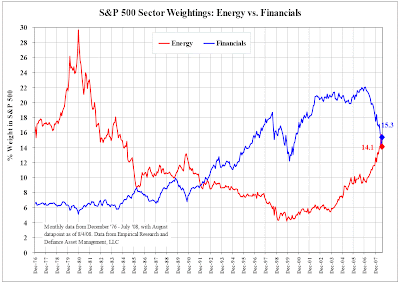
S+P 'Weighting' Game - Financials Vs. Energy

Over the past 15 years (since 1993), the Financial sector has enjoyed a larger 'weighting' (a larger influence) on the performance of the U.S.'s S+P 500 index relative to the Energy sector. However, per the below chart, times are changing and changing QUICKLY.


The 'modern era' PEAK difference between the weighting of the 2 sectors looks like it occurred in 2004 when Financial-based stocks made up about 21% of the S+P 500 vs. Energy's 6%. If you'll recall this so happens to coincide with the PEAK of the U.S. Housing Bubble (coincidence ? I think NOT). Since 2004 there has been a HUGE reversal in this once 15 year trend...and the influence of Energy and Financial sectors on the S+P 500 are now almost IDENTICAL !


Anecdotally thinking, I wonder if we'll eventually see a return to the 1980 scenario in which Energy stocks account for 30% of the S+P 500 vs. the 6% weight of financials (1980...not as long ago as one might think !)


images.thestreet.com/tsc/common/images/storyimages


Data Courtesy: RealMoney.com

Friday, August 1, 2008

Trinity - WIND At Its Back (or FRONT) ?


Trinity Industries
(TRN), the $3 Billion marketcap entity based out of Texas, is a DIVERSIFIED industrial company by every sense of the word. Its Business Segments include :


* Rail : manufacturer of railcars + provider railcar leasing services

* Construction Products : manufacturer of highway equipment, provider of highway services, supplier of construction materials including concrete and asphalt

* Inland Barge : manufacturer of large, inland sea platforms needed for the shipping of both dry goods (grain, coal, etc.) and liquid cargo (crude oil, ethanol, fertilizer, chemicals, etc.)

* Energy Equipment : manufacturer of structural WIND towers + propane tanks


While its Largest business unit by FAR is RAIL (per the below, 'Rail-related' operations accounted for over 70% of the company's total 2Q08 sales), I find the company's Energy Equipment business to be the most promising and exciting. Trinity is the country's largest manufacturer of structured WIND Towers. Per their 2Q08 earnings report, the company's WIND Tower division DOUBLED its Sales year over year and now accounts for approx 11% of the company's total revenues. Perhaps more significant is the fact that the company's Wind Tower order backlog grew 88% year over year (to $1.5 Billion) and Trinity now expects total 2008 WIND division sales of about $425 million.


For my future reference, below are some more interesting TRN 2Q08 Earnings Report #'s :


* Total 2Q08 Sales: Up 6% to $945 million (from 2Q07's $892 m)
Rail Related Sales: Down 11% to $677 m (from $762)
Construction: Up 11% to $219 m (from $197)
Energy Equipment: Up 58% to $157 m (from $99)
Inland Barge: Up 25% to $151 m (from $121)
WIND Tower Division: Up 100% to $106 m (up from $53)


* Total 2Q08 Operating Profits: Up 35% to $150 million ($111 m)
Rail Related Profits: Down 21% to $108 m ($137)
Construction: Up 31% to $21 m ($16)
Energy Equipment: Up 117% to $25 m ($12)
Inland Barge: Up 286% to $27 m ($7)
WIND Tower Divison: Not disclosed


* Total 2Q08 Operating Margins: 15.9% (12.4% a year ago)
Rail Related: 15.9% (18.0)
Construction: 9.6% (8.1)
Energy Equipment: 16.1% (12.1)
Inland Barge: 17.9% (5.8)


* 'Rail-related' sales and profits above are derived from combining the results of two of TRN's Rail-Related business units - 'Rail Group' and 'Railcar Leasing and Management Services'
* TRN's 'Wind Tower' sales and profit results are seperately broken out above but are actually included in the company's 'Energy Equipment Services' business unit


* Wind Tower BACKLOG grew 88% yoy to $1.5 Billion (from 2Q07's $800 million)

* Wind Tower Sales as a % of Total Energy Equipment revenues grew from 54% in 2Q07 to 68% in 2Q08

* Wind Tower Sales as a % of Total Company Sales grew from 6% of TRN's total 2Q07 to 11% in 2Q08 (in other words, the sales impact of TRN's WIND tower business doubled year over year in terms of influence to the company's Top Line)

* Energy Equipment Sales as a % of Total Company Sales grew from 11% of TRN's total 2Q07 to 17% in 2Q08

* Rail-related Sales as a % of Total Company Sales decreased from 85% in 2Q07 to 72% in 2Q08

* Rail-related Profits as a % of Total Company Profits decreased from 91% in 2Q07 to 72% in 2Q08

* Energy Equipment Profits as a % of Total Company Profits increased from 11% in 2Q07 to 17% in 2Q08

------------------------------------------------------------------------


* TRN expects Railcar (not including Rail leasing services) margins to decline from 12.3% in 2Q08 to 6-8% in 3Q and 3-5% in 4Q due to higher commodity costs ('plate' steel) and a more competitive pricing environment...TRN's 2Q07 railcar margin was 16.1%...TRN's previous provided railcar margin guidance for the 2nd half of 2008 was 6-9%


* TRN's railcar order backlog of $2.4 Billion (28,600 railcars) comprise 46% of the Industry's TOTAL


----------------------------------------------------------------------------


* CEO Timothy Wallace on TRN's WIND division: "I remain very optimistic about our structural Wind Towers business. We continue to explore additional ways to expand our participation in the wind energy market. We are very pleased with the Texas Public Utility Commission’s decision to fund additional transmission lines for wind energy. Texas is at the heart of our market and we expect the TUC’s action will encourage our customers to pursue additional wind farms. We have targeted Mexico and the central part of the United States, as our key markets. Order enquiries remain very strong and we expect our backlog to grow, as we progress through the year. A large backlog enables us to stage our growth and maximize our efficiencies. Later this year, we will start converting two existing railcar facilities to Wind Tower production. This is part of an expansion plan that we have in progress to satisfy the growing demand for wind towers. Our ability to convert a facility from one product to another is a key strength in our company. It allows us to aggressively pursue orders for a variety of products. We can select products, which provide the best returns and then quickly ramp up facilities. Our highly skilled workforce makes this possible...We do know though that, We are the Largest Producer of Wind Towers in the Country."


Full Disclosure: I own shares of TRN.

Friday, July 25, 2008

A Windy Proposition - MarketShare + Cost

According to the Brussels based industry group, Global Wind Energy Council, WIND Power made up 1% of the World's Electricity Production in 2007 and is expected to make up 3% in 2012.


According to EIA data, U.S. Electricity from --- COSTS :
* WIND: costs about 8 cents per kilowatt-hour

* SOLAR: costs about 15 cents per kilowatt-hour

* COAL-fueled electricity: costs 4 cents per kilowatt-hour


Also worth noting, Rising material costs (steel) have driven up wind turbine prices by about 20% since July 2007.


http://www.bloomberg.com/apps/news?pid=20601109&sid=a9B6qZ11iwwc&refer=home


Data Courtesy: Bloomberg

Friday, July 18, 2008

The Revolutionary Pickens Plan

Just for the record, I am a fan of T. Boone Pickens' Alternative Energy Plan.

The Mission Statement - "The Plan calls for building new WIND generation facilities that will produce 20% of our nation's electricity and allow us to use NATURAL GAS as a transportation fuel. The combination of these domestic energies can replace more than 1/3 of our Foreign Oil Imports. And we can do it all in 10 years."

http://www.pickensplan.com/theplan/

BP on Crude Oil (The Crisis):
* In 1970 the U.S. imported 24% of its CRUDE Oil needs..now this number is about 70%
* At current oil prices ($130 a barrell), we spend about $700 billion dollars a year importing crude oil into the U.S. — this is 4 times the annual cost of the Iraq war
* The U.S., 4% of the world's population, accounts for about 25% of the world's oil demand (every day 85 million barrels of oil are produced around the world and 21 million of those are used here in the United States.)
* World oil production peaked in 2005 (TB is a believer in 'Peak Oil'). Despite growing demand and an unprecedented increase in prices, oil production has fallen over the last three years.

BP on Wind Power (solution for electricity):
* The U.S. is the Saudi Arabia of Wind power as studies from around the world show that the Great Plains states (Kansas, Montana, Nebraska, New Mexico, North Dakota, Oklahoma, South Dakota, Texas and Wyoming) are home to the greatest wind energy potential in the world.

* Wind power currently accounts for 48 billion kWh of electricity a year in the United States — enough to serve more than 4.5 million households. That is still only about 1% of current demand, but the potential of wind is much greater.
* Building wind facilities in the corridor that stretches from the Texas panhandle to North Dakota could produce 20% of the electricity for the United States at a cost of $1 trillion. It would take another $200 billion to build the capacity to transmit that energy to cities and towns.

BP on Natural Gas (solution for transportation fuel):
* Natural Gas is the cleanest transportation (autos) fuel available today...According to the California Energy Commission, critical greenhouse gas emissions from natural gas are 23% lower than diesel and 30% lower than gasoline.
* Natural gas vehicles (NGV) are already available and combine top performance with low emissions...there are more than 7 million NGVs in use worldwide, but only 150,000 of those are in the United States (2%).
* Natural gas is our country's 2nd largest energy resource (COAL is #1) and a vital component of our energy supply. 98% of the natural gas used in the United States is from North America. But 70% of our oil is purchased from foreign nations.
* Domestic natural gas reserves are twice that of petroleum. And new discoveries of natural gas and ongoing development of renewable biogas are continually adding to existing reserves.
* We currently use natural gas to produce 22% of our Electricity. Harnessing the power of wind to generate electricity will give us the flexibility to shift natural gas away from electricity generation and put it to use as a transportation fuel — reducing our dependence on foreign oil by more than one-third.


Data Courtesy: PickensPlan.com

Sunday, June 8, 2008

U.S. Energy Consumption by SOURCE

Per 2006 data from the EIA, U.S. Energy Consumption by SOURCE:

1. OIL --> 41%
2. Coal --> 23%
3. Natural Gas --> 22%
4. Nuclear --> 8%
5. Renewable (Solar, Wind, etc.) --> 7%


*Click the below images for a larger view:


Data Courtesy: EIA